Opencode Go vs Claude Code: A real 11-day analysis
I’ve been using Opencode Go intensively for 11 days to test its models and the tool’s capabilities. I tried different models, from the cheapest to the premium ones, and observed how they perform in architecture tasks, refactoring, and Vibe Coding. With good prompting techniques, applying Spec Driven Development (SDD), Caveman and RTK, I achieved good results at a low cost.
My $10 subscription gives me a $60 API consumption limit, of which I already used $50 in just 11 days. That made me wonder: what if I switched to Claude Code? During this time I was also testing the Claude Code pro plan, but I ran into usage limits that made me question whether it’s really the best option for my usage pattern, mainly when using Claude Opus 4.7.
Here’s the real data. How much I spent, on which models, what would happen with Claude Code’s limits, and why paying more doesn’t always mean a better setup.
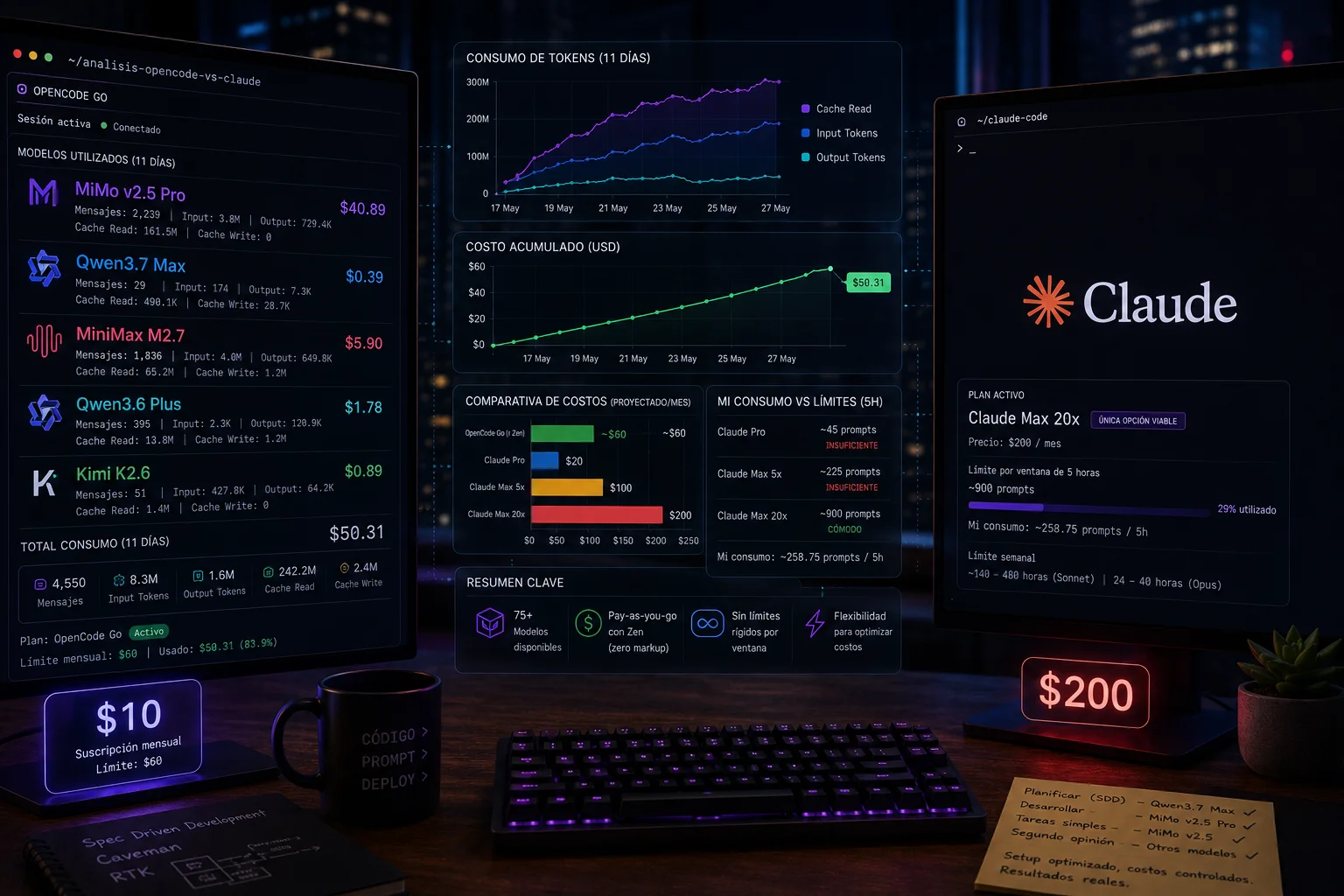
My Opencode Go usage over 11 days
General summary
| Metric | Value |
|---|---|
| Total cost | $50.31 |
| Average cost/day | $4.19 |
| Average tokens/session | 533.7K |
| Median tokens/session | 44.7K |
| Input | 8.3M |
| Output | 1.6M |
| Cache Read | 242.2M |
| Cache Write | 2.4M |
This doesn’t mean I paid $50.31. I paid $10 for the subscription, but I generated $50.31 in consumption. Consumption is what determines whether I exceed the monthly limit ($60) or not.
Usage by model
| Model | Messages | Input Tokens | Output Tokens | Cache Read | Cache Write | Cost |
|---|---|---|---|---|---|---|
| MiMo-v2.5-pro | 2,239 | 3.8M | 729.4K | 161.5M | 0 | $40.89 |
| MiniMax M2.7 | 1,836 | 4.0M | 649.8K | 65.2M | 1.2M | $5.90 |
| qwen3.6-plus | 395 | 2.3K | 120.9K | 13.8M | 1.2M | $1.78 |
| kimi-k2.6 | 51 | 427.8K | 64.2K | 1.4M | 0 | $0.89 |
| qwen3.7-max | 29 | 174 | 7.3K | 490.1K | 28.7K | $0.39 |
Analysis of the numbers
MiMo-v2.5-pro took 81% of the budget ($40.89 out of $50.31). That makes sense — it was the model I used to build some projects and where I spent the most time experimenting. Also, this was before Xiaomi MiMo lowered its API prices, which makes it even more attractive for developers with high consumption. With current prices, the cost of Mimo v2.5 Pro would be $2.86, 93% less than the $40.89 I paid, representing only 5.7% of total consumption.
MiniMax M2.7 processed 41% of my messages (1,836 out of 4,550) and only cost 12% of the total ($5.90). My pattern is clear: I delegate repetitive tasks to cheap models and reserve the premium ones for deep reasoning. MiniMax M2.7 costs $0.3 per million input tokens and $1.2 per million output tokens, well below most other models.
Cost per message:
Total cost: $50.31
Total messages: 4,550
Cost per message: $0.011
The system read 242.2M tokens from cache. It’s aggressively reusing context to maintain memory across sessions. Without that cache, the input cost would skyrocket.
During the 11 days, I worked almost 100% of the time with Vibe Coding, which explains the high number of messages and tokens. I can say that the models I used surprised me a lot, especially Mimo v2.5 Pro and MiniMax M2.7, which achieved real development, understanding complex context and generating high-quality code. The only thing I had to do was define the plan well with Spec Driven Development (SDD) and iterate at this stage.
Claude Code plan limits
The concrete numbers of my average consumption:
- 4,550 messages in 11 days = 414 messages/day
- Assuming 8 hours of active use: 51.75 messages/hour
- In a 5-hour window: 258.75 messages
Now let’s compare with each Claude Code plan:
Pro
- Price: $20/month
- Limit per 5-hour window: ~45 prompts
- Weekly limit: ~40–80 hours of Sonnet
With my average of 258.75 messages per 5-hour window, the Pro plan wouldn’t work. By mid-morning I’d already be seeing rate limit errors. It’s not a viable option for intensive use.
Max 5x
- Price: $100/month
- Limit per 5-hour window: ~225 prompts
- Weekly limit: ~140–240 hours of Sonnet + 15-35 hours of Opus
With 258.75 messages per window, I already exceed the 225-message limit — imagine with Opus, which consumes the limit ~35% faster than Sonnet.
Max 20x
- Price: $200/month
- Limit per 5-hour window: ~900 prompts
- Weekly limit: ~140–480 hours of Sonnet + 24-40 hours of Opus
With 258.75 messages per window, I’d consume ~29% of the base limit (900 messages). But it costs $200/month.
Claude Code locks you into Anthropic models. You lose access to MiniMax, Qwen, Kimi, Mimo, and the rest of the stack that today does the heavy lifting for pennies.
Comparison table: side by side
| Aspect | OpenCode Go (+ Zen) | Claude Pro | Claude Max 5x | Claude Max 20x |
|---|---|---|---|---|
| Base cost/month | $10 | $20 | $100 | $200 |
| My projected spend/month | ~$60 | $20 | $100 | $200 |
| Available models | 75+ | Claude only | Claude only | Claude only |
| Limit per 5h | Flexible | ~45 prompts | ~225 prompts | ~900 prompts |
| My consumption vs limit | No ceiling | Insufficient | Insufficient | Comfortable |
| Model flexibility | High | Low | Low | Low |
| Access to Opus | Yes (via API) | No | Yes (xhigh) | Yes (xhigh) |
Claude Max 20x is the only option that gives me headroom for my current usage pattern. But it costs $200/month, a huge leap compared to OpenCode Go’s $10. And that cost isn’t justified if I can manage my consumption with OpenCode Go + Zen for much less, with the model flexibility I need. If I exceed the $60 limit, I simply top up credits on Zen and keep working without interruptions.
Opencode Go also has usage limits, but they are much more flexible than Claude Code’s. I can use different models depending on the task, improve my prompts to reduce tokens, and adjust my consumption without worrying about rigid limits.
OpenCode Zen
For those who need more than the OpenCode Go base subscription, there’s a path: OpenCode Zen, which activates automatically when you exceed the $60 limit.
It’s pay-as-you-go. You add $10 in credits, pay only for what you use, and if you want, it auto-recharges when your balance drops below $5. No monthly commitment, no “prompts per 5 hours” limits.
If I maintain this same pace on OpenCode Go, to cover my shortfall this month I’d need to add about $50-60 in Zen credits. That gives me exactly what I need without switching tools or losing the models I use.
OpenCode Zen offers zero markup. You pay for models at the original API price, with no surcharges. You have your own API account without fighting with multiple providers.
It’s not permanent. I can cancel anytime and go back to my $10 subscription. It’s a bridge, not a move.
Xiaomi MiMo Token Plan
The Token Plan is Xiaomi MiMo’s credit-based subscription system, designed specifically for AI programming scenarios. Unlike traditional pay-as-you-go billing, this plan offers fixed monthly or annual credit packages. In the monthly Lite plan, for example, you pay $6 for 4,100,000,000 monthly credits and each message consumes credits based on the model and the number of tokens processed.
| Model | Input (Cache Hit) Token | Input (Cache Miss) Token | Output Token |
|---|---|---|---|
| mimo-v2.5-pro | 2.5 Credits | 300 Credits | 600 Credits |
| mimo-v2.5 | 2 Credits | 100 Credits | 200 Credits |
Using the same token reference we used for mimo-v2.5-pro in OpenCode Go:
| Model | Messages | Input Tokens | Output Tokens | Cache Read | Cache Write | Cost |
|---|---|---|---|---|---|---|
mimo-v2.5-pro | 2,239 | 3.8M | 729.4K | 161.5M | 0 | $40.89 |
The cost in credits would be:
| Concept | Tokens | Credits |
|---|---|---|
| Cache Read (hits) | 161.5M | 403,750,000 |
| Input (misses) | 3.8M | 1,140,000,000 |
| Output | 729.4K | 437,640,000 |
| Total | 1,981,390,000 (~1.98B) |
That would consume 1.98B credits, which in Xiaomi MiMo’s Lite plan would be 48.32% of the monthly 4.1B credit package for $6.
If we processed all of Opencode Go’s consumption on Xiaomi MiMo, the difference between models is notable:
| Concept | Tokens | mimo-v2.5-pro | mimo-v2.5 |
|---|---|---|---|
| Cache Read | 242.2M | 605.5M credits | 323M credits |
| Input (misses) | 8.3M | 2,476.3M credits | 380M credits |
| Output | 1.6M | 943M credits | 145.9M credits |
| Total | ~4B credits | ~849M credits | |
| % of Lite plan ($6) | 98% | 21% |
With MiMo-v2.5-pro we almost exhaust the 4.1B credit Lite plan. With MiMo-v2.5 we only use 21%, and there’s still room for much more usage.
With this analysis, I believe it’s worth combining OpenCode Go and Xiaomi MiMo Token Plan: use models like Qwen3.7 Max for planning and Spec Driven Development (SDD), reserve MiMo-v2.5-pro for development and refactoring, and leave MiMo-v2.5 for less critical tasks. This improves credit consumption and reduces costs without sacrificing quality.
Conclusion
After 11 days, 4,550 messages, and $50.31 in consumption, I’m clear that for intensive personal use, model flexibility matters more than the tool’s name.
Claude Code is good, but its plans are designed for a different usage pattern, increasingly restrictive and focused on enterprise use. The Pro plan falls short in minutes, the Max 5x doesn’t keep up during high-activity windows, and the Max 20x (the only viable one) costs $200/month and locks you into the Anthropic ecosystem.
OpenCode Go with its $10 subscription gives me access to many models, without rigid time-window limits. When I exceed the monthly cap, OpenCode Zen lets me keep working with pay-as-you-go and zero markup. I add credits only when I need them, with no monthly commitments.
The combination with Xiaomi MiMo Token Plan opens another door. If your workflow depends heavily on MiMo-v2.5-pro, you can significantly reduce costs using their credit system, reserving OpenCode Go for models that MiMo doesn’t cover. Additionally, Xiaomi MiMo recently lowered its API prices, making this option even more attractive for developers with high consumption. The prices are now on par with Deepseek V4 but with more powerful models.
My current personal setup: OpenCode Go ($10) + Xiaomi MiMo Token Plan. Estimated monthly cost: $16. Five times less than Claude’s Max 5x plan. I use Qwen3.7 Max for planning and Spec Driven Development (SDD), MiMo-v2.5 and MiMo-v2.5-pro for development and refactoring, and the other models for testing and getting a second opinion. With this setup, I have no interruptions from usage limits, I have access to a variety of models, and I maintain controlled costs.
For professional work, I use the tool my job provides, whether it’s Claude, Cursor, Codex, or anything else. The most important thing is to keep testing tools and understand how to be more efficient with them.
The perfect tool doesn’t exist. What matters is which one fits your usage pattern. If you’re the type who codes for 8 hours straight, delegates tasks to cheap models, and reserves the premium ones for what matters, the numbers speak for themselves.
If you want to replicate the analysis, check your consumption. If you exceed $20/month, consider a pay-as-you-go option before abruptly switching tools.