Building a Fortress in the Cloud: Cloud Native and Multicloud as Pillars of Robustness
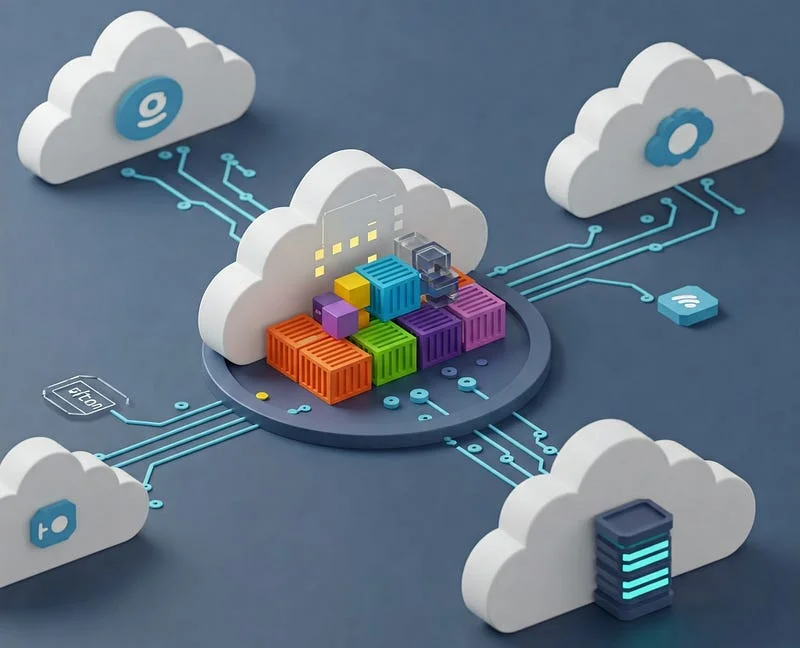
In the dynamic digital world, the robustness of our cloud infrastructure is not just desirable, but essential. The ability to withstand failures, scale seamlessly, and maintain operational continuity is crucial for any organization. This is where Cloud Native and Multicloud strategies converge, acting as fundamental pillars for building an inherently solid and reliable cloud.
Personally, I had the valuable opportunity to experience firsthand the power of this synergy between 2022 and 2024. I worked immersed in an environment that wholeheartedly embraced Cloud Native and Multicloud philosophies, which allowed me to not only understand their theoretical potential but also extract the maximum value from their practical application. My experience focused on the integration and simultaneous management of Google Cloud Platform (GCP) and Microsoft Azure. We managed to establish a workflow that enabled the deployment of applications flexibly across both clouds, strategically leveraging the most suitable services and particular strengths that each platform offered. This approach provided us with notable resilience, significant cost optimization, and unprecedented agility to innovate and respond to business needs.
What Do We Mean by Cloud Robustness?
In the context of cloud computing, Cloud Robustness implies the comprehensive capacity of a cloud environment to operate in a reliable, resilient, and efficient manner under diverse conditions and challenges. It goes beyond simple availability and encompasses multiple dimensions:
- High Availability (HA): The ability of systems and services to remain operational and continuously accessible to users, minimizing or eliminating planned or unplanned downtime. This is often achieved through component redundancy and automatic failover.
- Resilience: The ability of a system to recover quickly and maintain functionality after a failure, error, or unexpected event (such as a traffic spike, hardware failure, or software error). A robust system can absorb disturbances and return to a normal operational state with minimal interruption.
- Fault Tolerance: The ability of a system to continue operating correctly even in the presence of failures in one or more of its components. Highly fault-tolerant systems often use replication and sophisticated error detection and correction mechanisms.
- Elastic Scalability: The ability of a cloud environment to automatically increase or decrease resources (such as computing capacity, storage, or bandwidth) in response to demand fluctuations, without affecting performance or availability. A robust system can scale efficiently to handle variable workloads.
- Data Integrity: The guarantee that data stored and processed in the cloud is accurate, consistent, and protected against corruption or loss, even in the event of system failures. This involves backup mechanisms, replication, and data validation.
- Security: The implementation of comprehensive measures to protect data, applications, and cloud infrastructure against unauthorized access, cyber threats, and vulnerabilities. A robust environment includes strong defenses at multiple layers.
- Disaster Recovery (DR): The ability to restore IT infrastructure and operations quickly after a catastrophic event (such as a natural disaster or large-scale cyberattack) that causes significant disruption. A robust DR plan minimizes downtime and data loss.
In summary, Cloud Robustness refers to the strength, reliability, and ability of a cloud environment to maintain its critical functions and protect its assets against a wide range of operational challenges and unforeseen events, ensuring business continuity and user trust. It is a multifaceted attribute built through architecture, technologies, processes, and policies implemented in the cloud.
Cloud Native
At its core, Cloud Native is a software development and architecture approach designed specifically to take full advantage of modern cloud computing capabilities. It’s not just about “moving” applications to the cloud (often referred to as “lift and shift”), but about designing and building applications for the cloud, leveraging its scalability, elasticity, resilience, and agility.
The Fundamental Pillars That Define Cloud Native
- Microservices: By decomposing applications into independent, autonomous services, the failure of one doesn’t bring down the entire application. This isolates problems and facilitates recovery.
- Containers: Containers provide a consistent and isolated environment for each microservice, minimizing dependencies and conflicts that could cause instability.
- Container Orchestration: Platforms like Kubernetes automate the deployment, management, scaling, and self-healing of containers. Imagine having to manually manage hundreds or thousands of these “blocks” of your application; Kubernetes handles that, ensuring everything runs in a coordinated and efficient manner.
- Infrastructure as Code (IaC): Automating infrastructure through IaC reduces human errors and enables the creation of consistent, replicable environments, facilitating disaster recovery.
- Observability: Implementing monitoring, logging, and tracing systems provides deep visibility into application performance and health, enabling early detection and rapid problem resolution.
- DevOps: Cloud Native fosters a culture and practices that integrate development (Dev) and operations (Ops). This involves automating build, test, and deployment processes (CI/CD — Continuous Integration/Continuous Delivery), enabling faster and more frequent software delivery with higher quality.
Benefits of Cloud Native
Agility and Delivery Speed:
- Frequent and Rapid Deployments: Microservices allow teams to develop, test, and deploy small parts of the application independently and frequently, without affecting the entire system. This accelerates the software development lifecycle and enables rapid response to business needs and user demands.
- Automation: DevOps practices and CI/CD (Continuous Integration/Continuous Delivery) inherent to Cloud Native automate much of the development and deployment process, reducing human errors and time-to-market.
Scalability and Elasticity:
- Horizontal Scaling: Cloud Native applications are designed to scale horizontally, adding more microservice instances as needed to handle demand spikes. This is much more efficient and cost-effective than vertical scaling (increasing resources of a single server).
- On-Demand Elasticity: Container orchestration like Kubernetes can automatically scale resources based on workload, optimizing costs and ensuring optimal performance even during peak traffic periods.
Resilience and Availability:
- Fault Isolation: If a microservice fails, the rest of the application can continue running thanks to the distributed architecture. This minimizes the impact of errors and improves overall system availability.
- Self-Healing: Orchestration platforms can detect container failures and automatically replace them, contributing to higher availability and reducing the need for manual intervention.
- Fault Tolerance: Cloud Native design encourages building fault-tolerant systems capable of handling errors and continuing to operate in a degraded manner rather than failing completely.
Cost Optimization:
- Pay-Per-Use: By leveraging cloud elasticity and dynamically scaling resources, organizations only pay for what they actually use.
- Better Resource Utilization: Container density and efficient resource management by orchestration allow better utilization of underlying infrastructure, reducing operational costs.
- Reduced Operational Complexity: Automation and centralized management simplify operations, which can translate into lower staffing costs and greater efficiency.
Accelerated Innovation:
- Adoption of New Technologies: The modular microservices architecture facilitates the adoption of new technologies and programming languages for different parts of the application without affecting the rest of the system.
- Safe Experimentation: Teams can experiment with new ideas and features in specific microservices with lower risk to the entire application.
Portability and Flexibility:
- Vendor Independence: While not inherent to Cloud Native itself, the containerized nature of applications facilitates their portability between different cloud environments or even hybrid environments (combination of public and private cloud). This reduces vendor lock-in and offers greater flexibility.
Multicloud
Imagine that, instead of relying on a single utility company for electricity, water, and internet at your home, you decide to hire different providers for each service. Perhaps one company has the best electricity rate, another offers the purest water, and a third gives you the fastest internet connection. Multicloud operates under a similar logic, but applied to cloud computing services.
At its core, Multicloud is a strategy in which an organization uses cloud computing services from two or more different cloud providers. It’s not simply about having a presence in multiple clouds, but about actively using each provider’s specific services for different needs and workloads.
Benefits of Multicloud
- Resilience and High Availability: Distributing applications and data across multiple clouds reduces the risk of a single point of failure. If a provider experiences an outage, critical workloads can be switched to another cloud, ensuring business continuity.
- Avoiding Vendor Lock-in: Depending on a single provider can cause long-term cost issues and limit the ability to leverage new technologies from other providers. Multicloud offers greater flexibility and bargaining power.
- Cost Optimization: Different providers offer different pricing models and discounts. Multicloud allows choosing the most cost-effective option for each specific workload.
- Access to Specialized Services: Each cloud provider excels in particular areas (AI/ML, data analytics, databases, etc.). Multicloud allows accessing the best services for each need.
- Regulatory and Geographic Compliance: By deploying workloads in specific regions of different providers, organizations can comply with local regulations and improve latency for users in various geographic locations.
- Accelerated Innovation: Experimenting with services from multiple providers fosters innovation and allows development teams to choose the most suitable tools for each project.
Multicloud Challenges
While the benefits are significant, adopting a Multicloud strategy also presents challenges:
- Management Complexity: Managing resources, security, and governance across multiple cloud environments can be complex and require specialized tools and skills.
- Interoperability and Portability: Ensuring that applications and data can move easily between different clouds can be a technical challenge.
- Consistent Security: Implementing uniform security policies across all cloud environments is crucial but complex.
- Cost Management: Monitoring and optimizing costs across multiple platforms requires sophisticated tools and strategies.
- Governance and Compliance: Establishing clear governance policies and ensuring regulatory compliance in a distributed environment is essential.
The Powerful Synergy: Cloud Native + Multicloud
The true power lies in combining both strategies:
- Cloud Native applications, with their resilient and portable architecture, are ideal for deployment in Multicloud environments, leveraging infrastructure diversity for greater availability.
- Kubernetes, as a Cloud Native orchestrator, can manage containers across multiple cloud providers, providing an abstraction layer and facilitating robustness management in a distributed environment.
- DevOps practices and automation are crucial for managing the complexity of a Cloud Native Multicloud environment and ensuring consistency in robustness policy implementation.
Adopting a strategy that combines Cloud Native and Multicloud is not just an option, but a necessity for organizations seeking to build a truly robust cloud presence. By prioritizing resilience in application architecture and diversifying underlying infrastructure, companies can minimize risks, ensure operational continuity, and build a solid foundation for future innovation.
Recommendations
Implement Centralized Cloud Resource Management
It is highly recommended to establish a unified management layer that offers a comprehensive view and centralized control of all cloud resources, regardless of the underlying provider. This involves adopting tools and platforms that allow inventorying, monitoring, and managing assets from GCP, Azure, AWS (or others) from a single control point.
Centralized management provides greater environment visibility, facilitates the application of consistent policies (security, compliance, governance), and simplifies troubleshooting. Additionally, it improves operational efficiency by reducing the need to navigate through provider-specific consoles and tools, optimizing management and overall resource availability.
Establish Centralized and Proactive Cost Control
It is crucial to implement a centralized cost control system that allows tracking, analyzing, and optimizing expenses across all cloud providers in a unified manner. This involves using Multicloud cost management tools that offer granular spending visibility, allow setting budgets, configuring alerts, and performing comparative analyses across platforms.
Centralized cost control not only provides a clear view of total cloud spending but also facilitates identifying areas of inefficiency and optimization opportunities. With this consolidated perspective, time and resources associated with managing scattered costs across multiple platforms are avoided, enabling informed and proactive decisions to maintain financial efficiency.
Conclusion
To conclude this analysis, it is evident that the strategic convergence of Cloud Native and Multicloud represents a fundamental paradigm for achieving unprecedented robustness in the cloud. While Cloud Native equips applications with the agility, resilience, and intrinsic scalability needed to thrive in dynamic environments, Multicloud offers an additional layer of strength by diversifying infrastructure and mitigating the risks inherent in depending on a single provider.
My direct experience between 2022 and 2024, working on orchestrating workloads between GCP and Azure, tangibly corroborated the theoretical benefits we have explored. The ability to select the most advantageous services from each platform, combined with the portability and efficient management facilitated by Cloud Native, not only optimized costs and improved agility but also significantly strengthened the resilience and availability of our applications.
Ultimately, for organizations seeking to build a truly solid cloud presence, capable of withstanding the challenges of the digital world and scaling confidently into the future, the synergistic adoption of Cloud Native and Multicloud is not simply a recommendation, but an essential strategy. By embracing agility in architecture and diversity in infrastructure, companies can forge a robust technological foundation that drives innovation and ensures operational continuity in a constantly evolving landscape.
When exploring the successful adoption of Cloud Native and Multicloud strategies, two emblematic examples that often stand out are Walmart’s Cloud Native Platform (WCNP) and the launch of Fury by Mercado Libre.